Friday, 20 December 2013

12 Years On and What Have We Achieved in Afghanistan?

With the departure of troops from Afghanistan intended for 2014 and David Cameron’s recent trip to Camp Bastion to declare, or rather infer, ‘mission accomplished’ it seems Afghanistan is finally over.

Yet, the media was quick to draw parallels between G. W. Bush’s speech aboard the USS Abraham Lincoln on Iraq in 2003 due to their disbelief that coalition forces have managed to secure any of their objectives. They were not far off the truth.

Soldiers appear bemused?

The objectives were to:

Disable Al Qaeda

Yes, Mr. Cameron you have the right to fist bump the air as Coalition forces did disable Al Qaeda within their area of operations. However, Al Qaeda typifies a new form of actor on the international stage, one that does not have a set piece of land. Therefore, capturing a certain town or a capital will not destroy it as it is the ideology and the people which embody the organisation. To destroy this it will take localised actors, a shift in ideology or a reconciliation process. None seem likely.

Disable the Taliban

Driving the Taliban from Afghanistan is difficult. The Taliban, like Al Qaeda, are now partially removed from a certain spatial space. Yes, you can predominately find them in the south of Afghanistan but that is simply because they are predominately Pashtun and gain support from Pakistan. Moreover, Pakistan presents another issue as the Pashtun constitute the majority within the northern regions. This makes it easier for Taliban fighters to cross the border but coalition troops cannot as it violates the independent statehood of Pakistan. Finally, the villagers are reluctant to inform on the Taliban as they fear reprisals as Coalition forces wind down their processes.The Taliban’s Qatar office which was seen as an embassy for a government in waiting accentuates the point. Likewise, when Coalition forces arm villager defense forces against the Taliban they often end up being shot by the same weapons they gave out the week before.

The belief that the Taliban are slowing their attacks or waiting till Coalition forces pull out is unfounded. We just are not hearing about the attacks because it is the Afghan National Army that are taking the brunt of the fighting.

This article by the BBC talks in-depth about village defense forces and the arguments for and against them.

Ahmadzai tribesmen
Militias have had little success. Credit: BBC

Additionally, more Taliban attacks have started to occur in the Western and Northern areas of Afghanistan which are typically seen as safe areas for the Karzai government. It is likely that the Taliban are trying to suggest that Karzai has a lack of control over the whole state. He personally agrees, stating that:
“The entire NATO exercise was one that caused Afghanistan a lot of suffering, a lot of loss of life, and no gains because the country is not secure.”

There goes the whole ‘mission accomplished’ rhetoric… put your fist down Mr. Cameron.

(Important to note that when I refer to the Pashtun I am not stating they are all Taliban but that the Taliban are mainly of Pashtun or external origin).

Drug Prevention

This seemed to be an objective at the beginning of the campaign however it has declined as this year saw a bumper crop of poppies in Afghanistan. 6000 tons, the biggest since the invasion began, was harvested.

Conversely, Afghanistan’s 2000 drug eradiction program under the Taliban was highly effective with production falling to 185 tons in 2001 compared to 3300 tons in 2000.  It was even acknowledged at the October 2001 session of the UN General Assembly though since the war started the Coalition has been keen to distance itself from this.

Yet, the reduction in opium did have detrimental outcomes for the farmers as they struggled to feed their families. Wheat needs more water and earns no money until it is sold. The opium trade gave the money up front.

See this article for more information.

Create a stable and loyal Afghan National Army (ANA)

Yes, no, maybe?

Well some ethnic and political faction leaders have begun to revive their militia forces should the international drawdown lead to a major Taliban push to retake power. Successful? Erm, no?

This was illustrated in a November 2012 meeting organized by Herat leader Ismail Khan, in which he reportedly began taking steps to reorganize his Soviet and Taliban-era militia. Vice President Muhammad Fahim has also discussed potentially renewing the Northern Alliance force in anticipation of the need to assist Afghan government forces against the Taliban. And Uzbek leader Dostam is also reportedly trying to reorganize his loyalists in northern Afghanistan. These and similar moves could spark ethnic and communal conflict from an all-out struggle for power and a reversion to Afghan rule by faction leaders rather than elected leaders.

US forces training the Afghan National Army.

Do armies even work in a clan based societies?

Armies need to be centred on a shared common identity and a goal. At present the ANA comprises of Afghans from the North with the goal of fighting the Taliban south. The title is misleading as it is not a national force, rather what resembles the Northern Alliance with a few new toys courtesy of the coalition.

For a rather stimulating and patriotic history of the Taliban and what the Americans have done about it read this:
So moving on to 2014 about 8,000 to 12,000 American trainers and Special Forces will remain in Afghanistan alongside with 5,000 coalition forces. Clearly some way to go and that means that not all forces are pulling out. It is one of those "we said we would pull all the troops out but then..."

In the realm of international politics that is sort of understandable.

Provide proficient Aid

This article would not fit in to my blog if I did not discuss aid. But, it is kind of the same story again - I'm really noticing a trend.

The aid is going through the governments of Kabul and thus the people are being told what they need!
Only in 2008 did the UK gov ask the people what they wanted and were truly shocked by the answer that came back.


Basically, as per, see this Ben Anderson documentary on Afghanistan. There is also a more recent one entitled 'This Is What Winning Looks Like'.

And if you prefer to listen to all the arguments surrounding Afghanistan listen to reliable Ben talking to VICE. Good discussion on women rights and the views of a typical Afghan villager.

Thoughts welcome as always.

Tuesday, 17 December 2013

Syria and the Global Arms Trade

In the run up to Christmas we are all frantically buying presents for loved ones, ensuring deadlines are complete so we can avoid thinking about them, and becoming a little more focused on ourselves and our families. 

There is nothing wrong with that. In fact we deserve a break! Or certainly I will admit I need one!

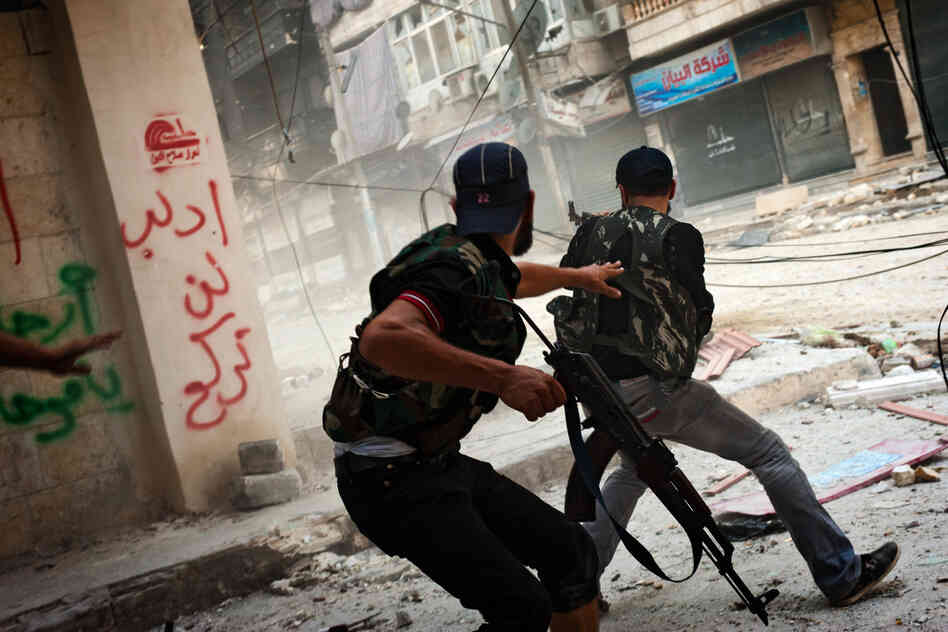
But, as we prepare to celebrate another Christmas and hunker down it was strange to hear that yesterday the BBC launched a series of reports on the Syrian conflict to mark its third year - almost like a birthday? Oddly it seems like only yesterday that fifteen children in Deraa wrote anti-government graffiti and the subsequent violence started.

After three years of fighting, what can we infer from the situation? 

Well it is rather stale… in fact it is a stalemate.

That does not mean that fighting is not occurring but rather that rebels will take one area for it to be only retaken by government forces and vice versa.

Sustained firefights on the streets of Aleppo. Credit: James Lawer Duggan

Concerning the BBC report it concluded that the influence of external powers will be the deciding factor in this conflict; an observation that could be drawn from most, if not all, armed conflicts in this present age. Cheers for that BBC… we do indeed live in a globalised world so external powers are bound to take an interest and have an influence.

Conversely, in  studies on the Middle East and North Africa (MENA) major scholars in democratisation such as Diamond, Linz and Lipset (1996) exclude the MENA  states from their studies as they “lack much democratic experience, and most appear to have little prospect of transition to even semi-democracy”. This lack of democracy simply makes this region even more interesting to external powers as it is so volatile. Volatility means vast amounts of money and where there is money there is bound to be trouble.

So, let us have a quick look at how have the external powers influenced Syria recently?
  • They have given non-lethal aid to the Free Syrian Army (FSA) but due to the Islamic Front taking FSA bases in Bab al-Hawa the aid has stopped to this region.
  • Aid for refugees and those suffering from the now crippling winter has been provided. Though it is risky for aid workers to complete their jobs.

This aid seems rather cautious and concerned with the people of Syria’s welfare. However, underneath this bubble of aid lies a more sinister trade, the arms trade. If external powers are not involved in this then… well we all know they are.

So what makes weapons profitable?
  • Their durability.
  • The ease with which actors can locate ammunition. Obviously finding ammunition for an AK47 is easier than another rarer or outdated rifle. 
  • They are fungible and interchangeable.
  • They retain their value
  • Conflict seems to be a constant at this present moment so someone will always want to buy them
Read this article here for a more in-depth understanding and an overview of the arms trade.

Vast stockpiles of weapons in unstable states. See this article on the arms trade in Latin America.

Who is supporting who?
  • Russia and Iran are supplying the Assad regime
  • External powers such as America are not explicitly trading arms but are facilitating the transfer of arms from Libya to Syria rebels. The logic is that the more weapons fired at Assad means fewer weapons in the hands of militants in North Africa. Sound logic.
Furthermore, if you watch ‘Holidays in the Danger Zone - The Violent Coast: Liberia and Sierra Leone’ by Ben Anderson (I would recommend his documentaries) about sixteen minutes in he finds an RPG-7 provided by a British Arms Manufacturer despite the arms embargo on Liberia. Thus, as Western powers attempt to reduce conflict in developing states it is worth considering how they might be sustaining them or profiteering from them.

Nonetheless, they are playing a game which all foreign powers play from Pakistan to China to Russia and consequently for them to be involved, no matter how irresponsible, might help to prevent certain powers from dominating the international sphere.

I would argue that all should be aware of this practice but that preventing the arms trade presents a conundrum needing international cooperation. Calling for the West to stop trading arms could lead, however inhuman this appears, to worse atrocities. If both sides are armed then a realist state of deadlock may emerge. Though, if this is broken after sustained vertical proliferation, and with more weapons available, the conflict could be prolonged. It is a difficult situation.  

Therefore, as we spend Christmas buying lots of presents lets us take a minute to think about the way in which armed forces throughout the world are able to buy their ‘presents’ this Christmas. I urge you to consider the arguments, research the subject and form your own opinions on this important matter.

Resources used (if not already linked):
Diamond, L., Linz, J. J. and Lipset, S. M. (1995) Politics in Developing Countries: Comparing Experiences with Democracy. Boulder, CO: Lynne Rienner.

Sunday, 25 August 2013

Trust in Aid

It's certainly been a while since I last posted a blog on aid but it has not been off my mind. Lack of a computer, internet and Wifi have prevented me from posting sooner but I've been having some interesting discussions with many aid workers and other notables about the issue of trust.

Simply, those in developing countries rarely trust organisations to deliver what they need. Also, we unanimously agreed that trust is the most prevalent issue facing the implementation of Western aid. I'll look at why it is such an issue and how we can begin to resolve it.

Trust forms the basis of most relationships in aid, business and everyday life. If you look in the news today (that being the 25th August 2013) you'll notice an article focusing on Lord Sacks criticism of society. He states that when 'trust breaks down, you see institutions break down'. Well if we are having an issue in this Western and apparently 'developed' world it is not surprising that the developing world is thinking 'hold on, why are they telling me what to do? Our sense of community is stronger then theirs and maybe individualism just is not for us'.

So, firstly we can hardly preach down to developing countries when we are so guilty of different but still challenging issues.

In a different way I think our generation has become too fixated on the short term. The 'I want, I need this now' attitude then replaced the next day by wanting something different is atypical (I must add I'm not a saint on this issue I'm just as guilty as the next person).This issue of short-term projects affects aid in a similar way. These projects look great on paper, often are great in their implementation but as soon as the project finishes often people slowly return to their old way of life. Watch this video with Paul Kagame, president of Rwanda, in which he explores this issue, the economy and you may infer that the shielding aspect of aid is devaluing individuals:


'There is bad aid and there is good aid. The bad aid is that one which creates dependencies, but good aid is that which is targeted to create capacities in people so that they are able to live on their own activities.'

Furthermore, focusing on food aid developing countries are starting to question why food aid is always offered at every turn. Why is the technology required to feed themselves held back? This is all to do with the developed world's strategic interests. If you read Chris Barrett and Dan Maxwell's book entitled Food Aid After Fifty Years: Recasting It's Role they argue that aid is:


  • It is a donor-driven system
  • It promotes domestic interests of donor countries
  • It is a foreign policy tool
  • International institutions are driven by exporters
  • Development is not necessarily the objective
If these reasons are analysed alone then food aid seems to be solely for the benefit of Western powers. Of course there is food aid out there that is driven by a need to serve others and often it does save lives. It's just the dependency culture that it creates that I take issue with.

What can we do? It's simple. We should stop getting involved in economies where we stylise this as helping but in reality we are exploiting developing countries (Shell in the Niger delta comes to mind). Moreover, we should implement projects that encourage long-term aims and if the going gets tough we should stick it out. If we fail to control the issue of trust then in the future it will become much harder to get involved in the developing world. We need to be in it for the whole ride not just the way up and we need leave developing countries wanting more aid not being forced to receive it.

Wednesday, 24 July 2013

Child Soldiers - Who, What and Why?

I am taking a break from finance because the developing world is not, strangely, all about finance… gasp! In fact though we tend to measure everything and anything using a monetary value countless travellers return from the developing world with a different view on what ‘life’ is and what to value after experiencing the child choirs of Africa, the hospitality of a poor shopkeeper in Thailand or the lively street parties of South America.

With that in mind I’m centring this article on understanding who are child soldiers, what happens to them after conflict and why the KONY 2012 campaign totally missed the point.These child soldiers are the emaciated generation ravaged by war in a world of finance which often neglects them.

What or who are child soldiers?

Children taught to kill before they can write
Child soldiers are children mostly taken from their communities by warlords to fight, or if female act as ‘wives’, in their armies and are coerced by fear, death and regulation.

The Lord’s Resistance Army, which was the focus of the Kony 2012 campaign, is led by Joseph Kony who forces children to kill other children that attempt to escape, commit atrocities and bans whispering. Whispering may seem a strange rule compared to the others but it is often the only way that children can plan their escape! Notably, some argue that Kony’s ability(?) to control spirits, an important part of the Acholi tribe’s belief system, contributed to his grip on his followers.

Children are taken because they are easier to mould into devoted followers unlike adults who have normally built up a resilient set of morals... hopefully?

In many war-torn areas children make up the majority of the population, are easier to feed and do not have a developed sense of danger.

What happens after the war when the children are freed?

Topically, we are beginning to discuss the effects of Post-Traumatic Stress Disorder (PTSD) on UK soldiers returning from Afghanistan and the consequences it has for the soldier’s family, mental health and lives (watch the recent Panorama documentary for more on the issue).

However, PTSD is already an issue rife among child soldiers, presenting a divide between him/her and their community due to a lack of understanding and the atrocities committed. Taking the LRA example above, if the ex-child soldier cannot sleep or screams throughout the night the villagers believe the child is still possessed by the evil spirit of Kony whereas the child is simply reliving the experience of battle or murder which is common among those who suffer from PTSD. Watch this video on Joesph, a former child soldier and Sergeant in the LRA, for a more detailed account.

A child soldier armed with a rifle and a teddy bear rucksack.
What is worrying is that child soldiers are taken before basic education is completed and therefore return knowing only one trade – the trade of death. In a post-conflict state the priority is to rebuild the damage done by the warlord or civil-war and therefore those with skills are prioritized in the effort. Ex child soldiers have no skills and consequently are left out of decision-making and employment. Children attempt to find any source of income and in some cases children have been known to dig up graves, selling the wood from the coffin and any trinkets from the dead.

This lack of employment forces many children on to the street, with no voice and nothing to occupy their minds. As a child soldier they were respected simply because of the fear, power they controlled and atrocities they committed – disarming the children was and is a priority for governments. It is when the children are disarmed and gain no form of employment I worry that they will be forced back into violence to re-claim their lost power. It seems that it is only when these children present a threat to a government will they gain the recognition they deserve. Indeed, the UN identifies youth alienation as a major factor in the 1991-2002 civil war that consumed Sierra Leone.


What are the governments doing?

It would be unjust to argue that governments have not attempted to remedy the plight of ex child soldiers. Below are just some of the schemes utilised:

  • Most governments or non-governmental organisations (NGOs) have offered cash for weapons to remove them from the hands of child soldiers.
  • Providing education.
  • Offering courses in Vocational Skills Training for Enterprise Capacities (VSTEC) in trades such as electronics, catering and mechanical engineering.

These schemes have worked in some parts of the developing world. Substantially, I know from my intern that VSTEC courses in Sierra Leone are helping the youth create businesses that are relevant and needed within the market. In Bo, Pujehun, Moyamba, Bonthe, Kenema and Tonkolili districts some 1,800 trainees are studying in selected vocational training centres (VTCs).

Yet, within Liberia under a similar scheme, Tim Dokie, a 28-year-old former combatant, stated that, 'I was only praying for the teachers to hand me the tool kits promised at the end of the training, which I readily sold for $15'.

Evidently these programmes have varying levels of success…
Furthermore, offering cash for weapons presents problems due to its individualistic approach which fails to address why so many cheap weapons can be found within Africa. Arms traders, developed states and other African states are often behind the arms trade because conflict is simply a source of immense wealth for some. If you have the time reading this article by the Integrated Regional Information Network entitled 'Analysis: How best to remove guns from post-conflict zones' sheds more light on the issue.
In one such case the UK enacted a food embargo on Sierra Leone in 1997 yet Sandline, a UK Arms dealer, supplied arms to the Economic Community Cease-Fire Monitoring Group (ECOMOG) during the troubles. Initially, ECOMOG was a peace-keeping force which helped restore order but in the following years many human rights abuses have been levelled against the organisation including Nigerian Alpha Jets strafing unarmed civilians. The food embargo largely affected the civilian population and not the intended target, the junta, even though weapons still found their way from the UK into Sierra Leone.

ECOMOG defended Sierra Leone's government

To conclude, children who are taken at night, cast into lives of murder, rape and atrocities and mostly forgotten by the governments who should have protected them in first place deserve to have a right to education or a means of providing for their basic needs. Nonetheless, looking beyond the ex child soldiers the state needs to occupy the minds of these children to safeguard the fragile peace that now exists. Investment from foreign powers will provide employment but the involvement of these alienated youth is paramount. Finally, removing weapons from Africa should become an agenda in the developed world instead of covertly supplying them.

Oh and the Kony 2012 campaign was a bit late as Kony had moved to the Central African Republic by last year so it didn't do much... apart from making the Ugandans think Kony was coming back to Uganda! I know I'm just as guilty for sharing it but it has made me realise how quickly our generation mobilises our support on an issue we don't understand because of a flashy video... opps.

If you want to find out more about child soldiers and their plight visit
WarChild

Tuesday, 23 July 2013

ROSCAs - The Advantages, Disadvantages and Everything in Between.

Following the previous blog about loans and savings this blog will focus on what financial options are available to those in rural areas where finance is in the hands of the villagers. The advantages, disadvantages and everything in between. 

Let's start with ROSCAs or Rotating Saving and Credit Associations.

Individuals meet at pre-defined intervals of perhaps a week or a month and contribute small amounts of money into a 'pot'. Notably, ROSCAs have been used by those with high incomes in the developed world and therefore income is exogenous to ROSCAs. They are simply common  in rural parts of the developing world, 50 to 95% of Adults engage in them in the Congo, Cameroon, Gambia, and villages of Liberia, Ivory Coast, Togo, and Nigeria (Bouman [1995] for references),due to the advantages discussed later. ROSCAs operate by either:

  • Each interval giving the total to one individual. You can only receive the contents of the 'pot' once.
  • Conducting a lottery, with those members who have already received their payouts being excluded from the lottery.
  • Bidding, in which members who want the money most bid an additional sum to that which they have contributed. When the winner is known his or her contribution is then shared out equally. This is a relatively unknown in Africa.

The advantages of ROSCAs: 
  • Social capital getting to know contacts or information within the ROSCAs.
  • A range of different ROSCAs exist - religious, market, ethnic, office or neighborhood.
  • Women tend to utilise them more then men the due to social and financial (normally lower income) reasons. For instance, in Kibera the probability that a woman is involved in a ROSCA is 40% compared to a man at 10.1%. Further, a study in Nairobi by Anderson and Baland (2002) showed that a women's bargaining position in the household is directly related to her contribution to household income.
  • ROSCAs offer a personal source of income for women, particularly in Africa. Men in Africa are seen as 'deserving' personal spending money whereas a woman's income is collective. The work of Hoddinott and Haddad (1995) empirically verifies this claim for African households where, relative to women, men spend a greater portion of their income on goods such as alcohol and cigarettes,whereas women are more likely to purchase goods for children and for general household consumption.
  • Transparency due to group regulation.
  • Efficiency - money is put in the 'pot', the meeting occurs and the money distributed in the chosen way. 
  • Can be tailored to the income of the group.
  • The savings of many are transformed into a lump sum for one person. This is often used to improve household livelihoods, to invest in a new business or to pay school fees.
  • Protect an individuals savings against immediate consumption - identified as particularly beneficial for women (Anderson and Baland, 2002)
  • Offers a protection against theft as savings are not left within houses

The disadvantages of ROSCAs: 
  • If the ROSCA distributes money by prior agreement or by lottery it is unlikely to be available at the time in a business cycle when it is most useful. These types of ROSCA are often then used in order to save up for household durables such as utensils or roofing sheets. They are an effective savings instrument, but relatively ineffective as a means of capitalising productive investment 
  • The amount of money is fixed and may be inadequately matched to a person’s investment plans 
  • There is no return on people’s investment in a ROSCA, except a marginal time-value of-money benefit of receiving a lump sum at no interest cost before reimbursement 

Further findings:
  • ROSCAs are not a substitute for credit but rather complement it. But, are often the sole saving and credit institutions in many rural areas.
  • While, ex ante, all individuals are better off by saving through a ROSCA, the member who receives the pot last is ex post worse off. Particularly if investment is set. For instance:
  1. The purchasing power of a pound is slowly decreasing due to inflation. 
  2. If ten individuals put ten pounds into a ROSCA then each week an individual at random is given one hundred pounds. 
  3. At the beginning of the ROSCA one hundred pounds will have the equivalent purchasing power.
  4. However, after ten weeks one hundred pounds may equate to less purchasing power, say ninety eights pounds, then at the beginning of the ROSCA.
Simply if a ROSCA 'pot' was ten pounds and could buy you ten apples at the beginning you may only be able to buy nine apples at the end of the ROSCA due to the price of apples inflating. Yet, orders of ROSCAs change every cycle? Not really... Anderson and Baland (2002) contend that ROSCA orders rarely change and often follow the first pattern which does not explain why the last recipient would stay and by backwards induction why the ROSCA does not break down.


Last in the ROSCA queue means less apples for you! Fair?

In conclusion, the rationale proposed by Besley, Coate, and Loury (1993) concerning the financial detriment the last member to receive the pot suffers is not debatable. However, ROSCA must benefit the members in many other ways, apart from financially, to explain the high usage in developing states. These benefits are listed in the advantages section and include social capital, self-sufficiency for women who argue that they 'should not rely on their husbands' and the ability to tailor the individual investment per pre-defined interval to the level of income of the members.

Monday, 22 July 2013

Building an Understanding of Loan and Savings Schemes for a Stronger Community

Taking out a loan in the UK is difficult at present and talking to my friend yesterday who has set up his own tree-surgery business just typifies this. He is working seven days a week to make ends meet and on the suggestion that he should take out a loan he just responds, 'What's the point in buying expensive machinery if the next week there are no jobs? I'll survive that week but what if there is no work the next week and the next?' He has a point.

Nonetheless, if he did take out a loan, grew his business and then paid it back with the higher income then he might be left with a more recession-proof business. Well that is the logic anyway. It is a complex game of determination, experience and fortune.

So what have loans got to do with aid?


Well, microfinance (money on a smaller scale) is a relatively new addition to the arsenal of aid. Since the introduction of microfinance in Bangladesh by Nobel Peace Prize winner Muhammad Yunus it has been one of strongest financial tools used to create sustainable projects, raise incomes and resolve conflict in communities. Alongside the realisation that women are better clients because they generally put the money towards development. Rather, the men often look towards the short-term, alcohol and themselves. A tad sexist but it’s a correlation that is shown in most aid programmes… sorry guys.


So what makes microfinance in the developing world different to the loans we get in the UK?


Within the UK we can be tracked due to the large amount of information we each output or is necessary to operate in the developed world. The government, banks and police know where we live, where we go and apparently now what we say in private (we all knew they did) so we cannot just simply default on a payment and slip away as we would be stopped at the border, frog-marched back and be forced to deal with the consequences. This traceability lessens the risk of the loan for the loaner which is reflected in the rates. Also, if the payments are matched to our incomes then we will be able to meet them unless we lose our job or overspend on other goods and services.


However, in the developing world the government, banks and police often have imperfect knowledge. Houses are not all aligned in pretty streets but rather everywhere and anywhere. Just imagine trying to find someone in the middle of a slum! Furthermore, unemployment is rife and even those with jobs have little security. The risk of loaning makes the loan’s interest rates higher and those with limited savings or income it is almost impossible to secure a loan.


That obvious theory aside, microfinance gets around these issues by tying a whole community into the loan and appeals to peer pressure to enforce repayments. A perfect solution.


Yet, I have been reading an essay entitled ‘What is the evidence of the impact of microfinance on the well-being of poor people?’ by Duvendack et al. which argues that micro-finance does not guarantee an improvement in the reduction of conflict. For instance, it states ‘access to credit for cash crop production controlled by men may result in reallocation of resources away from food crop production controlled by women, with adverse effects on their children's nutrition’ (pg. 10).


Nonetheless, I've heard and seen project statistics where communal loan schemes have been successively instrumental in securing the sustainability of a project. The need to repay keeps the beneficiaries focused and enables those without skills, particularly the youth, to learn, graduate and begin business. The argument that schemes which benefit one portion of the community over another does not dissuade me. An increase in income in Africa is directly coupled with a growth in that group’s rights and inequality is not solely sourced from microfinance schemes as a range of factors affect it including cultural norms, exploitation and livelihood choices.

This video is a testimony to the success of microfinance (if not a bit cheesy).


Microfinance unmistakably works. But, limitations occur in rural areas with poor infrastructure due to basic geography - they may be days away from the local(?) bank. Ergo, the microfinance schemes work more efficiently in semi-urban or urban settings as banking officials can cost-effectively monitor schemes.

So what schemes are available for those distant rural communities?  


A trend in savings rather than credit is identified in a Care report on ‘Village Savings and Loan Programmes in Africa’ as common practice in rural communities. A range of saving programmes exist under the Village Savings and Loan (VS&L) family including Rotating Savings and Credit Associations (ROSCAs) and Accumulating Savings and Credit Associations (ASCAs). ROSCAs operate by drawing together small contributions from all members and giving the total to one individual. ASCAs are similar but the total is not given to one individual but is applied to any project that the group chooses  These saving schemes enable those with a small income to gain access to a greater lump sum of money and further draws the community together due to regular meetings.

A more in-depth discussion of the advantages and disadvantages of these schemes shall be discussed in the next blog. 

Any thoughts? Anything captured your interest?

Thursday, 18 July 2013

Agriculture, Science and the AASW6

It's the 6th Africa Agriculture Science Week (AASW6) by the Forum for Agricultural Research in Africa (FARA) hosted by the Government of Ghana this week and I've noticed two things:
  1. Aid just seems to be one long list of acronyms making reading a report, post or blog difficult for outsiders. So within this blog I'm going to be committed to expanding every acronym I use and I want you the people to police me. 
  2. More importantly I'm struggling to keep up to date with the reports, posts and twitter feeds. There are a lot of useful, insightful and grounded responses to aid being made today and that makes AASW6 a big deal. Shame its not on the BBC news.
Here are some of the posts:

Kips Isaac ‏@Kipsizoo 17m
"Smallholder farmers hold the key to African development" - Dr Kanayo Nwanze at the #AASW6

IITA ‏@IITA_CGIAR 11m
AASW6 keynote by IFAD Pres: African governments need to invest more on agricultural research. #AASW6

IFAD ‏@IFADnews 2h
#Africa can feed Africa. Africa should feed Africa and Africa one day will feed Africa, says #ifad Prez @knwanze #aasw6

AAS CGIAR ‏@AAS_CGIAR 1h
We're partnering with org's at local, national & global levels to achieve impacts at scale in #Africa: http://bit.ly/WY7Fdi  #AASW6

Fairtrade Intl ‏@FAIRTRADE 1h
Great convo on smallscale farmers at #AASW6. And while at it, check out our take on powering up smallholders http://ow.ly/n57pg

Addressing my first point IITA stands for the International Institute of Tropical Agriculture and AAS is the African Academy of Sciences. They are a mouthful but at least we are all on the same wavelength now. Also, Fairtrade International's take on smallholders and the report is well worth a read if you have some time.

Focusing on the second point, evidently there is a lot of traffic surrounding this forum and it's pretty difficult to pick out the key message. To summarize, Africa feels that Africa can feed itself, should feed itself and must feed itself to secure its future. AASW6 believes that science can make this a reality.

So as I watch delegates take their seats on the live feed I cannot help but notice that this is a united Africa saying what they need to resolve the issue of hunger that decimates the continent. It is not us prescribing a resolution to the issues Africa faces and often our ways of providing food aid which breeds dependency, assembling schools that never fill and sending monetary aid that ends in corruption, doesn't work miracles (I appreciate this form of aid is necessary at times but I want to look at the long-term solutions). Rather, Dr. Kanayo Nwanze, president of the International Fund for Agricultural Development (IFAD), has declared that Africa holds unprecedented opportunities to resolve their own issues through science and create an industry which engages the youth. Our western magic is not working, the miracle of genetics and breeding will.

A smallholder supporting himself and Africa (Taken from IFAD blog

There is hope. Firstly, the work and strategies discussed in the AASW6 are entering onto a world stage. Secondly, Fairtrade International infers that the value of the smallholder is 'starting to be recognized as a potential powerhouse to fix a broken system'. Finally, Africa is not a hopeless case, is a rising star and must be recognized as a new frontier for sustainable economic growth.

Thoughts?